John Kruesi (English version)

Without Johann Heinrich Kruesi, there would be no record players, light bulbs, or insulated cables. Raised in an orphanage in Speicher, he emigrated to America in 1870 and became Thomas Edison's right-hand man in 1877.
John Kruesi's career is a prime example of what is known as a rags-to-riches story, which is often associated with the “American dream.”
(Table of Contents)
Biographical data
- Born on May 15, 1843, as the illegitimate child of Juditha Krüsi in Heiden and handed over to the Speicher orphanage in September 1851.
- Grew up in the Speicher orphanage, where he received minimal schooling and, like all orphanage boys, helped with weaving in the weaving cellar.
- Left the orphanage on April 28, 1860.
- Apprenticeship as a locksmith at the Kessler locksmith's shop in St. Fiden (St. Gallen), followed by years of training and travel in European countries.
- 1870 Emigrated to the USA, employed at the Singer sewing machine factory.
- 1871 Employment with Thomas Alva Edison, initially as an employee, then as a foreman and partner.
- 1873 Marriage to Emilie Zwinger, daughter of Jakob August Zwinger, a pharmacist in Thurgau; the marriage produced eight children.
- Brilliant designer, mechanic, and developer, some of the inventions are his own.
- Died on February 22, 1899, in Schenectady (New York).
Difficult childhood and adolescence
Kruesi's mother, Juditha Kruesi, gave birth to Johann Heinrich on May 15, 1843, as an illegitimate child, which was one of the most shameful things for a mother and child at that time. Those born out of wedlock usually faced difficulties throughout their lives. Juditha Kruesi sued the presumed father, either because she wanted to get married or because she hoped to gain an advantage for her son. The court ruling was a huge disappointment; the father was possibly an influential man who feared for his honor. In the verdict, Juditha Kruesi was found guilty of “false paternity suit, defamatory statements, and false accusations against the investigating authorities.” As punishment, she was sentenced to twenty lashes and four weeks in prison.

The child was taken away from her, as was customary in such cases at the time, and placed in the orphanage of her home community, Speicher. Johann Heinrich Kruesi arrived at the Speicher orphanage at the age of 8, having probably been raised by his grandmother in Heiden until then. From 1844 to 1847(?), “Juditha Kruesi and her illegitimate child in Heiden” were under guardianship according to entries in the Speicher bailiff's register. Juditha married Martin Tobler in 1847, but they divorced in 1850. It is not known whether Juditha Kruesi ever had contact with her son Johann Heinrich again.
At the orphanage in Speicher, children and young people were put to work as cheap labor in the weaving mill at an early age, as was customary at the time. By today's standards, this would be considered exploitation. The orphanage director was also the schoolmaster and “entrepreneur” of the in-house weaving mill, where the boys had to work to help finance their living expenses. As a result, their schooling was correspondingly poor. Alfred Altherr, who grew up with Kruesi in the home and later became a pastor in Basel, recalls in his memoirs “Beckenfridli,” published in 1897: "Johann Kruesi and I were nothing but little weavers. Three times a day we had to eat our porridge from small pewter bowls. We learned little, we were beaten with rods, and sometimes the wrong person was hit.“
Apprenticeship and travels
Johann Heinrich Kruesi was fascinated by the mechanics of weaving and embroidery machines from an early age. It was probably this interest that enabled him, at the age of 17, to begin an apprenticeship as a locksmith with master locksmith Kessler in St. Fiden near St. Gallen, with financial support from his community in Speicher. He also continued his education at night school, studying mathematics and technical drawing. After completing his apprenticeship and further training as a mechanic in Zurich, he set out on his travels. As a craftsman, he completed internships in Salzburg, Plauen, Copenhagen, Paris, and Hamburg, and for a short time he also worked for the United Swiss Railways in Rorschach, a private railway company. A visit to the World's Fair in Paris in 1868 (he walked to Paris!) probably prompted him to emigrate to America in 1870 at the age of 27, together with his colleague August Weber. They passed the time until the departure of the ocean liner by studying mechanical models at the South Kensington Museum.
In Edison's dream team
In New York, the two initially worked at the Singer sewing machine factory, where Kruesi had already demonstrated his talent for invention. They happened to hear about a man who was conducting interesting experiments and making inventions. Although Singer made them very good offers, they applied to Thomas Alva Edison's laboratory in Newark, which had opened in 1872, and were hired immediately.

Thomas Alva Edison (1847–1931) was already a celebrity at that time. Edison was undoubtedly a genius, but he was not a loner; he was a boss who today would be described as a team player. He had an unerring eye for good people, engaged them, involved them in his many companies, and formed them into a kind of dream team, a close-knit community of friends, innovators, craftsmen, engineers, visionaries, eccentrics, and geniuses. John Kruesi, as he now called himself, soon became one of Edison's closest and most productive employees, as Edison quickly recognized his talent, both in terms of his craftsmanship, due to his exact and precise working methods, and in terms of his character, due to his energetic personality, his perseverance, and his ability to motivate employees. Kruesi was loyal, and his coworkers and boss himself called him “Honest John.” Edison called him “his most talented mechanical engineer” and trusted him blindly when it came to building test models. According to Edison biographers Robert Friedl and Paul Israel, Kruesi was crucial to Edison's success: “If the inventions that came out didn't work, it was because they were bad, not because they were poorly made. And if the ideas were good, the products from Kruesi's workshop prove it.”
The two complemented each other perfectly: Edison was the “visionary,” whose inventive spirit was brimming with ideas. Krüsi was the brilliant engineer who could put Edison’s ideas into practice, thanks to his talent as a skilled mechanic.
A meteoric career
Edison initially made Kruesi head of the machine shop and later head of the laboratory in Menlo Park, where Kruesi contributed to all of Edison's epoch-making inventions, such as the phonograph, the light bulb, a large generator, and many others.
He also found time to continue his own inventive work: In addition to the Kruesi tubes, he patented nine other inventions, including self-adhesive insulating tape and trolleybus pantographs with underground contact lines.
Genius designer
On December 4, 1877, Kruesi found a very simple sketch on his workbench with the note: Kruesi, make this! Kruesi asked, “What is this supposed to be?” “The machine must be able to speak,” replied Edison. Kruesi set to work and tinkered, experimented, and crafted for two days until he had built a machine that corresponded to Edison's vague idea. Kruesi set to work and spent two days tinkering, experimenting, and building until he had constructed a machine that matched Edison’s vague idea.
-
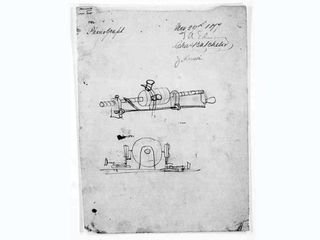 Edison's Sketch
 -
 Kruesi_Phonograph
 -
 Kruesi Phonograph Variant
 -
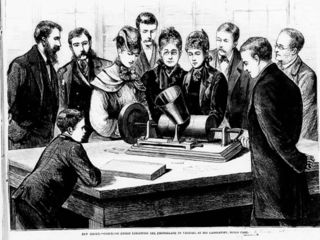 Demonstration with Kruesi (left)
 -
 A reminder from Edison


When Edison saw the phonograph for the first time, he turned the crank and recorded a nursery rhyme:
Mary had a little lamb;
its fleece was white as snow;
and everywhere that Mary went,
the lamb was sure to go.
In 1897, Edison, already an old man at that point, had the verse recorded again, as the original from 1878 had since been lost. The audio recording can still be heard today.
From engineer to entrepreneur
From engineer to entrepreneur
In 1886, a strike threatened Edison's young company. The premises in Menlo Park were no longer sufficient. Kruesi found a suitable replacement in Schenectady, where the business was relocated in 1887. Kruesi thus rose from foreman to general manager for the factory expansion of the up-and-coming General Electric Company. Kruesi also played a key role in the invention of the light bulb. As head of the laboratory in Menlo Park, then Schenectady, he experimented with platinum and carbon filaments, designed and manufactured mechanical parts, and tested pumps and glass bulbs. After more than a year of work, failures, disappointments, and hostility, the breakthrough came on October 19, 1879: the first light bulb with a carbonized thread made of sewing thread burned for 45 hours! Another pioneering achievement was Kruesi's construction of the dynamo for the lighting system on the steamboat “Columbia.”
-
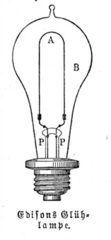 Sketch of a light bulb
 -
 Edison with a light bulb
 -
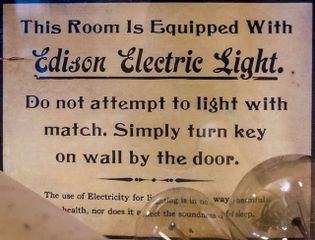 Note on the type of lighting
 -
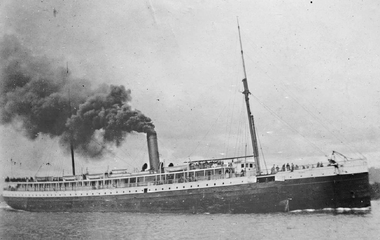 Steamship Columbia


The result was the establishment of a commercial power grid to bring new quality of light into homes. Kruesi headed the new company “Electric Tube,” which manufactured underground insulated cables for direct current, known as “Kruesi tubes,” conductors in iron pipes filled with hot tar as insulation material. They were used in the first Central Station in New York and thus in the first power grid in Manhattan. Initially, it was limited to an area of around 600m by 800m and supplied around 800 incandescent lamps on Pearl Street. After just one year, there were over 500 subscribers with more than 10,000 lamps. The network subsequently grew to over 30 km of Kruesi tubes. The cable factory was integrated into the Edison Machine Works company, where Kruesi became deputy director until he took over as head in 1886. In 1889, the machine factory, now integrated into Edison General Electric, was relocated to Schenectady, New York, with Kruesi as deputy head. In 1892, following further mergers, this became the General Electric Company, which still exists today, with Kruesi now serving as general manager of the original part of the company. This company alone grew from 200 to 4,000 employees in six years! A final career move in 1896 made Kruesi chief mechanical engineer of General Electric.
In addition to his work at the company, he was also involved as an expert in the construction of the Boston and Baltimore subways.
-
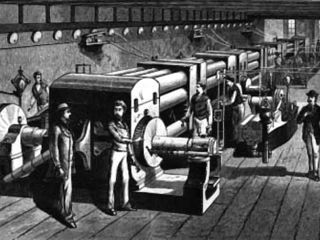 Interior of the power plant
 -
 Power plant Pearl Street 1888
 -
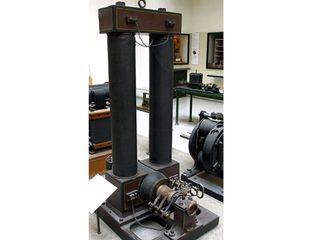 One of the first dynamos
 -
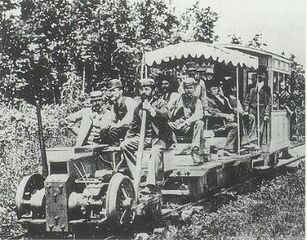 Kruesi as train engineer!


Happiness in his career and family

In 1873, in the USA he married Emily Zwinger, the daughter of a pharmacist from Thurgau. The couple had eight children. He probably never knew anything about his father, and there are few records of his mother's life. She married Martin Tobler from Teufen in Herisau on October 18, 1847. The couple had a daughter, Anna Barbara, on February 20, 1848. On October 1, 1849, Juditha gave birth to an illegitimate daughter, Anna Katharina, whereupon she was again convicted of fornication, this time to two years in prison.
John Kruesi died in 1899 at the age of not even 56, two years after his wife. His funeral was that of a king, according to a friend of Kruesi's. The family remained in America, where descendants still remember their famous ancestor today. General Electric also continues to honor the memory of its founder to this day.
Committed to the community
Although he became rich and probably happy in the USA, he must have cherished memories of his homeland, because his son Walter Edison Kruesi, whom Edison had sponsored, established the Walter Edison Kruesi Foundation in Appenzell Ausserrhoden with a capital of $100,000 "for projects that beautify and enrich the lives of the population, promote public health, create simple, small, pleasant parks and playgrounds, and, if necessary, to award scholarships to enable or facilitate higher education for capable, promising young people with a healthy sense of community.“
Kruesi-Clan
A large family tree
John Kruesi had 6 sons, one of them as a small child did not survive, but three daughters did. Four sons und two daughters married, of which the marriages of one son and one daugther remained childless. The descendants of the following generations gather together for famuily meetings, moustly in or iaround the area of Schenectady. On 29th July 2022 such a gathering with around 50 Kruesi-offspring, as the Daily Gazette Schenectady reported.here.

In the footsteps of their ancestors

Marianne Marck Kruesi visited Switzerland with her husband Neill Marck in the summer of 2018. In Speicher, the couple happened to stay at the orphanage where her great-grandfather had grown up. Marianne Marck Kruesi met with Peter Abegglen from wikispeicher and Roger Nobs, council secretary of the Canton of Appenzell Ausserrhoden and president of the Walter Edison Kruesi Foundation, to exchange ideas.

Kruesi Spirit of Innovation Award
The Kruesi Spirit of Innovation Award was established in 2001 by the Chattanooga Chamber of Commerce and descendants of John Kruesi. It is presented to companies that bring innovative products or processes to market.
Sources:
Historisches Lexikon der Schweiz
Helmut Stalder: «Verkannte Visionäre. 24 Schweizer Lebensgeschichten». Edited by Neue Zürcher Zeitung. ISBN 978-3-03823-715-0
Marianne Marck Kruesi, personal notes
Wikipedia
